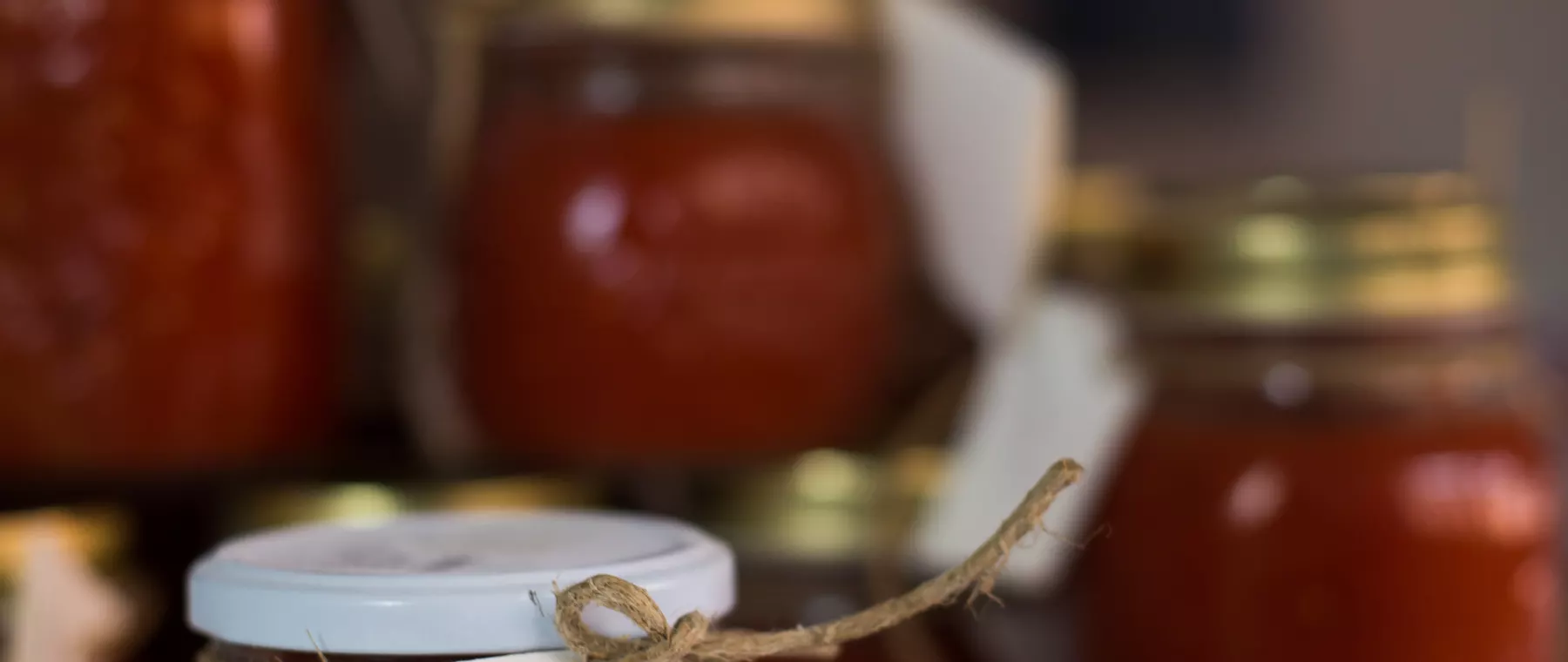
I have read so much about passata that it could fill the pages of a novel. From the type of tomato to use, to secret blends that bring out unexpected notes, from herbs, to garlic, to salt, to "oh no! I use onion".
Behind a passata can hide life's most radical certainties and uncertainties.
I found out that some people mix several kinds of tomato, from Piccadilly to oxheart, to balance texture and sweetness. In another case, which I must say inspired me quite a bit, I read about someone who fries bay leaves and uses the flavoured oil as the final layer before closing the jars.
Mine is a lazy, slightly rough-and-ready passata.
Anarchic, certainly, because I improvised on everything except the scrupulous care with which I sterilised the jars and equipment.
I have a certain allergy to recipes that take too long. Forgive me, maybe I belong to the generation that wants everything right now, but the idea of tackling passata has always unsettled me a little.
Years ago, in summer, when I could stay in the countryside with my parents, I would keep my mum company through this August torture, which sometimes went on for several days, even with the thermometer close to the humid 35°C of the Venetian mainland.
As a grown woman, I remember turning out pot after huge pot to restock the restaurant I worked for. Scalding splashes flying through the air, dozens of glass jars to sterilise, red crates as far as the eye could see, enough to redefine the concept of space-time, and the lids, where in the end there is always one missing. A rough road, in short, the road of passata, full of mishaps and sweat, and often mosquitoes too. Because San Marzano is no saint, and there is nothing idyllic about any of it.
And yet, despite all this, passata is the star of the most tender stories. A bit like childbirth, whose pain (so they say) you forget, passata comes storming back into our hearts as soon as the first breeze of late September ruffles our hair and our thoughts turn to the cold, green months ahead.
So, the passata I want to tell you about today is a sort of compromise that is anything but reverent towards tradition. In fact, I would rather say it aims to start my own personal tradition, in a fairly free and light-hearted way. I did not cut corners on the ingredients, all of them untreated: San Marzano tomatoes, unrefined salt, garlic from Abruzzo, dried bay leaves and a few tricks. Nothing more.
In the photo, the passata with a very special model: young Ada, known as Dadina.
Method
I started by sterilising the jars and lids. First I washed them with (a little) soap and water and rinsed them thoroughly. Then I laid them on an oven tray and put them in a cold oven. I brought them up to 100°C, then turned off the oven and left them to cool without touching them. I also put a couple of ladles in the oven, along with the metal funnel I would use to pour the sauce into the jars. From then on I wore disposable gloves.
Why was I so careful? Because with preserves there is a risk of botulism. In general, then, you need to be particularly thorough when washing the vegetables and sterilising the equipment. You can follow the guidance on the Italian Ministry of Health website (in Italian), which sets out the basic guidelines to stick to when making this kind of preserve.
I washed the tomatoes thoroughly in plenty of water, leaving them to soak for about twenty minutes so that any unwanted residue on the skins would come away. I threw away the water and put ¼ of the tomatoes in the sink. I filled the other half of the sink with cold water. I covered the tomatoes with boiling water and then plunged them into the cold water. This way it was easy and fairly quick to peel them. I repeated this until I had done all the tomatoes. I was not meticulous about it: I worked quickly instead, leaving bits of skin on. I just removed most of it and cut out the spot where the stalk joins. As I went, I cut them into quarters and put them in the big pot. I used 3 large pots, filled just over halfway. That way, once they come to the boil, the splashes will not jump out of the pot, burning you and spattering the hob (or the wall!). I brought the tomatoes to the boil, sharing the garlic, salt and bay leaves equally between the pots. I cooked the tomatoes for 1 hour, first over a high heat and then turning it down, stirring often. I took out the bay leaves and blended everything with a hand blender.
Yes, you read that right.
I did not pass the passata through a mill: I turned it into a rough sauce, which chopped up the leftover bits of skin. I put it back on the heat and let the (small amount of) excess water evaporate.
Then I poured the passata into the jars while still piping hot, using the funnel I had sterilised. I closed the jars tightly and left them to cool. Finally I placed them in large pots (I used 4), fitting them in so that they would not knock against each other too much. I know some people put tea towels between the jars, but I must say I did not need to. I covered the jars with cold water, making sure it came four fingers above their tops, and slowly brought it to the boil. Once it was boiling I counted half an hour, then turned off the heat and left them to cool.
I chose to do it this way because, personally, tomato seeds do not bother me, and because, since the tomatoes were organic, I found it absurd to go mad removing the skins when they also have nutritional value and their own flavour and texture. I did not add basil because I do not like cooking with fresh herbs: I find they lose much of their flavour and properties. I prefer to add a fresh leaf when I open the jar, and be free to choose whichever aroma I fancy depending on what I am using the passata for.
Oh, one last tip. I made the passata in early September. Sunny as it is, the weather is very different from August! But this cannot be a hard and fast rule, because it always depends on how the season has turned out.